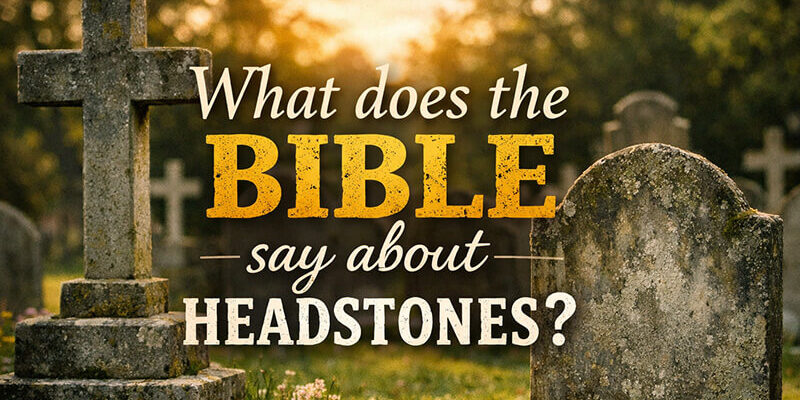
What Does the Bible Say About Headstones?
Exploring Biblical Perspectives on Memorial Markers
Table of Contents
When one loses a special person, it is, of course, a natural desire and instinct to go to great lengths to maintain that person’s memory. For centuries, headstones and memorial markers have acted as conduits of remembrance for the departed. But what does Scripture actually say about the use of headstones? One might be bemused at discovering that while the Bible does not say much about this formality, whether to recommend it or condemn it, it offers some fascinating examples of memorial stones.
Key terms you’ll encounter: OT (Old Testament), NT (New Testament), Gen. (Genesis), Josh. (Joshua), Sam. (Samuel), Matt. (Matthew), Chr. (Chronicles), Deut. (Deuteronomy), approx. (approximately), e.g. (for example), i.e. (that is)
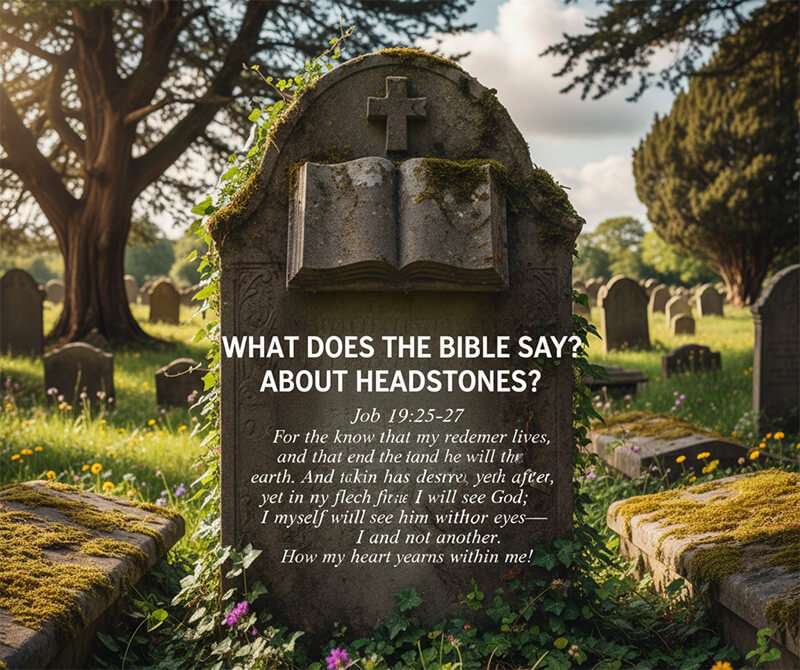 Biblical Evidence of Memorial Stones
In the Bible, references to memorial stones and grave markers abound in the OT. They were an attempt to keep a memory alive, honor persons, or deliberately commemorate events.
Jacob’s Pillar for Rachel: A particularly touching example can be found in Gen. 35:20. When Jacob’s dear wife Rachel died while giving birth, he erected a pillar over her grave. The text adds, “Jacob set a pillar on her grave, which is the pillar of Rachel’s grave to this day.” Of course, it symbolized a marker he put, but more importantly, it was an act of love and remembrance that spanned generations.
Absalom’s Memorial: We learn of another such example in 2 Sam. 18:18. Absalom erected a pillar in the King’s Valley during his lifetime, and in doing so he said, “It is to preserve the memory of my name”; he had no son to carry on his name. This shows that memorials served a purpose in that they were intended so that someone would not be forgotten.
📊 Fact: Archaeological evidence from ancient Israel testifies to the widespread use of stone markers for burial site designation—as confirmed by biblical descriptions. The distinction between these markers often reflected social standing, ranging from simple piled stones used by poorer families to carved pillars erected by those of higher status.
Purposes of Memorial Markers in the Scriptures
The Bible defines some very significant aims of memorial stones:
1. Remembering: The foremost aim was so that future generations would remember important persons or events. In Josh. 4:6-7, God told the Israelites to erect twelve stones as a memorial “so that in the future, when your children ask, ‘What do these stones mean to you?’ tell them…”
2. Honoring the Dead: Marking the graves was a sign of dignity and honour. This is something Jesus himself acknowledged in Matt. 23:29, saying that people “decorate the graves of the righteous.”
3. Practical Identification: In ancient times (approximately 2000–400 BC), memorial stones were markers that helped identify burial sites for the sake of visiting their family and for the maintenance of ceremonial purity under Jewish law (Num. 19:16).
Modern Examples from Around the World
Example 1: Sarah from Kenya
In a small village outside Nairobi, Sarah lost her grandmother, who had been the spiritual pillar of their community. Following both biblical principles and local Christian traditions, the family erected a simple granite headstone inscribed with her name, the dates, and Psalm 23. Sarah shares: “Every time we visit, we read the scripture on her stone. It reminds us that she rests in the Lord. The headstone isn’t just a marker; it’s a teaching tool for our children, just like the stones in Joshua. With that connection, there is great comfort in the midst of such loss.”
📊 Evidence: Studies suggest that a majority of Christian families choose to put scripture verses on headstones, seeing them as a last testimony to their faith.
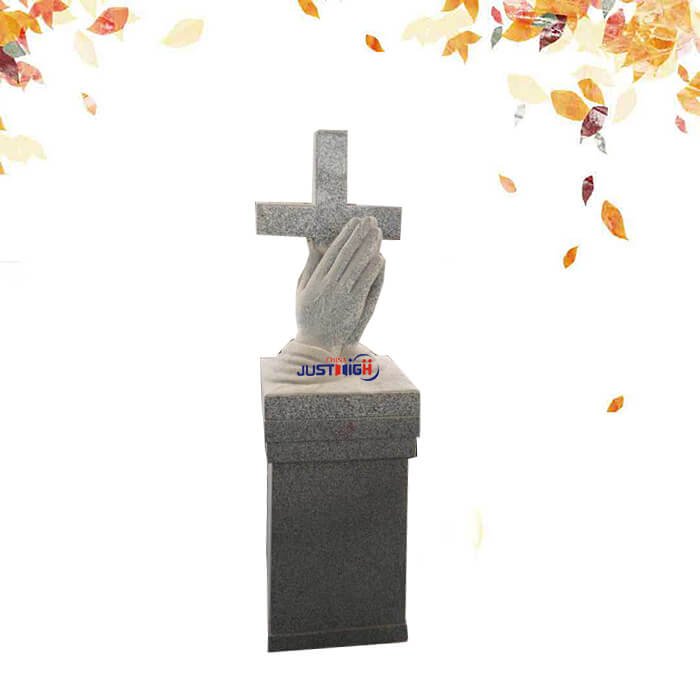 Example 2: The Chen Family from South Korea
When Pastor Chen died in Seoul, his family faced the momentous decision of whether to adhere to traditional Korean burial customs or adopt Western-style Christian practices. Hence they have chosen a kind of hybrid: the headstone carries inscriptions in both Korean and English, featuring John 11:25-26. His son states: “Father always taught that memorial stones, like those in the OT, serve as witnesses to God’s faithfulness. His headstone witnesses to the resurrection hope he preached for forty years.”
📊 Evidence: a significant increase has been observed since 2010 at Christian cemeteries in South Korea, revealing a growing want to mix biblical principles with memorial practices.
Christian Perspective Today
In this regard, Christians today have a great deal of freedom. The New Testament contains no prescriptions for burial, nor does it forbid headstones. The heart behind the memorial is what really matters, as is ensuring that it is not revered above the Lord (which would be an offense against the commandments in Deut. 5:8-9).
Many believers select headstones for these reasons:
- A place where family can meet and reflect
- An opportunity to testify to one’s faith through scripture inscriptions
- To honor the deceased with dignity and respect
- To create a tangible bridge across generations
⚠️ Important Balance: While headstones can be meaningful, it is important for Christians to remember that our hope is not in a monument but in the resurrection (1 Cor. 15:52). A headstone is just a means of remembrance, but it does not facilitate salvation or guarantee eternal rest. The focus must remain on Christ, not large memorials.
Conclusion
The Bible does not command the use of headstones but offers no prohibition against them either. From Jacob’s pillar for Rachel to Joshua’s memorial stones, the Scriptures tell us that it was always part of God’s people’s practice to mark important places and remember important people. What matters most is not whether we choose to have a headstone but how we truly honor our loved ones and point others towards the hope we have in Christ.
You may decide on a simple marker, a huge monument, or no physical memorial at all—it is up to you, your family, and God. The biblical principle is clear: remember with purpose, honor with dignity, and always keep the focus on the eternal hope we have through Jesus Christ (Rom. 6:23).
We Are Professional Headstone Manufacturers
Having been in the business of creating meaningful memorials for years, we realize the importance of offering dignity and respect to your loved ones. Our people use both old-world craftsmanship and modern techniques to create beautiful and lasting memorials. Whether you would like something grand or with scriptural verse inscriptions, we can always be available to collaborate with you to create a memorial reflecting the life and faith of your loved ones.