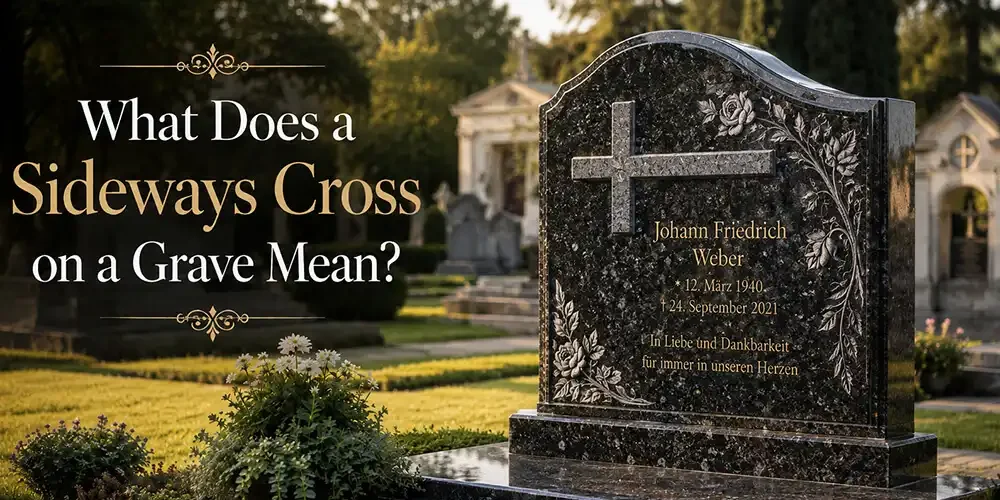
What Does a Sideways Cross on a Grave Mean?
If you spend much time walking through an older cemetery, you start to notice how much can be said with a small symbol. Roses, doves, praying hands, angels, crosses — each one tells part of a story.
One symbol that sometimes catches people off guard is a sideways cross.
We get asked about it from time to time: “Does it mean something different from a normal cross?” The short answer is yes for some families, but there is no single meaning that applies to every grave.
There Is No One Official Meaning
A sideways cross is still a Christian cross. The change in position does not create a new church symbol with one fixed meaning.
There is no widely accepted Christian teaching that says a horizontal cross on a grave must mean one certain thing. In most cases, the meaning comes from the family, the person being remembered, or the person who designed the memorial.
That is important, because grave symbols are often more personal than people expect.
For one family, a sideways cross may represent rest. For another, it may mean a journey has come to an end. Someone else may simply like the look of it.
That is why we never like to tell a family, “This symbol can only mean this.”
Memorials do not work that way.
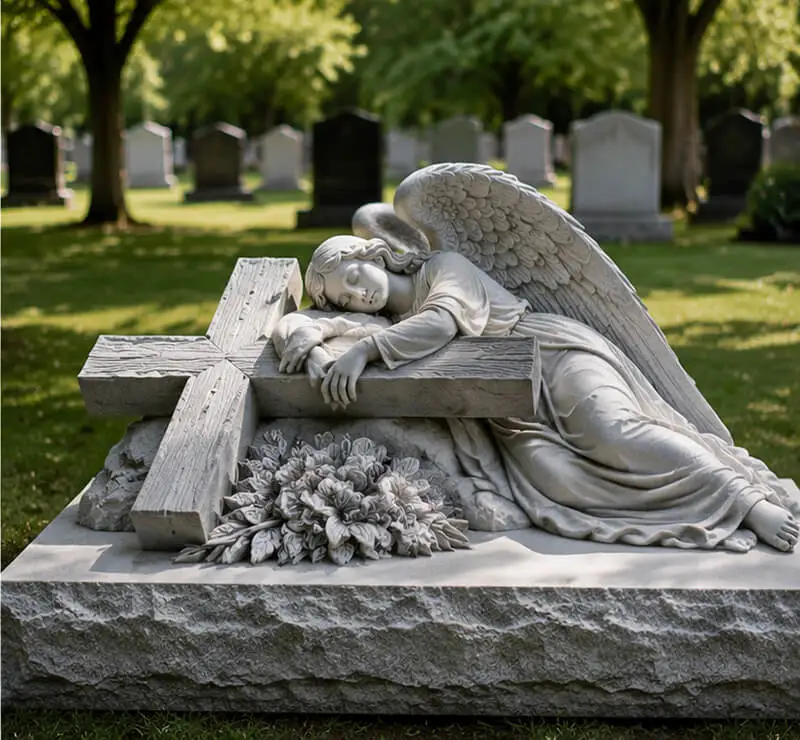
It Can Represent Rest and a Completed Life
One of the most common meanings people give to a sideways cross is rest.
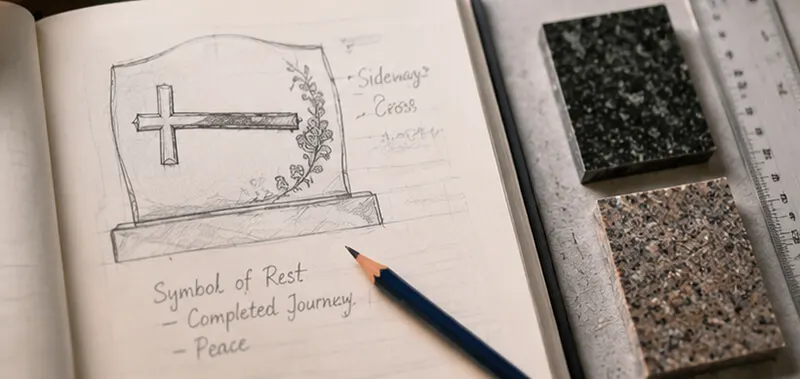
An upright cross feels strong and traditional. A cross lying across the stone can feel calmer, almost as if it has been gently laid down.
Some families see that as a sign that their loved one has finished their earthly journey and is now at peace.
We once had a customer looking at several cross layouts for his father’s headstone. He kept coming back to a simple cross placed across the lower part of the stone.
He said, “Dad was always busy. I like that this one looks like he can finally rest.”
That was all the meaning he needed.
It was not a rule from a church book. It was personal.
And that is often what makes a memmorial feel right.
Some Families See It as a Sign of Continuing Faith
Other families see the sideways cross in a different way.
To them, the cross shows that faith does not end with death. It remains part of the person’s story.
Christian crosses have appeared on grave markers for many centurys. They are among the most familiar religious symbols found in cemeteries across Europe, North America, Australia, and other Christian communities.
The position, shape, and carving style can vary a lot.
You may see Latin crosses, Celtic crosses, crucifixes, simple line crosses, or crosses carved into flowers and borders.
The sideway version is just one more way families make the symbol their own.
Sometimes It Is Simply a Design Choice
Not every symbol needs a complicated story behind it.
Sometimes a sideways cross fits the shape of the stone better.
We see this on heart-shaped stones, slant markers, flat markers, and wider granite monuments. A horizontal cross may sit beside a name, run under an epitaph, or become part of a flower or vine desgin.
From a monument maker’s point of view, balance matters.
A small upright cross may look lost on a wide stone. A cross placed across the lower section can make the whole layout feel more natural.
With CAD drawings, families can see the layout before the stone is cut. Some shops also use CNC equipment for lettering and carving, while QC checks help catch size or layout problems.
You may also hear terms such as PO, ETA, FAQ, DIY, ID, UV, and GPS when dealing with monument orders, delivery, cemetery locations, or maintenance.
Ask About the Person, Not Just the Symbol
When someone asks us what a sideways cross “really means,” we usually suggest looking at the rest of the gravstone too.
Is there a Bible verse nearby?
Are there flowers, praying hands, or an angel?
Is the cross next to the person’s name?
Did the famliy choose it because of a church tradition?
Those details often tell you more than the position of the cross itself.
A symbol can mean faith, peace, love, rememberance, or something known only to the family.
That is part of what makes cemetery art so interesting.
Before Adding One to a New Headstone
If you are choosing a sideways cross for a new monument, first check the cemetery’s rules.
Some cemeteries have limits on monument size, religious symbols, carving depth, or the type of marker allowed in a certain section.
A local monument dealer or funeral home can usually explain the requirments before production begins.
After that, choose what feels right for the person you are remembering.
You do not need to find a perfect textbook meaning.
If the cross reminds you of their faith, their peace, or the way they lived, then it already has meaning.
That is what a good monumant should do.
It should feel less like a piece of stone and more like a small part of someone’s story.