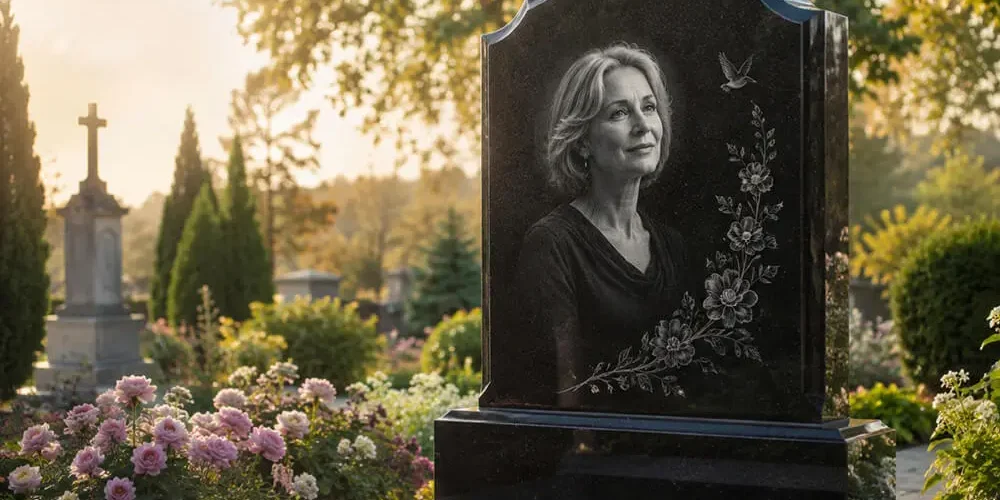
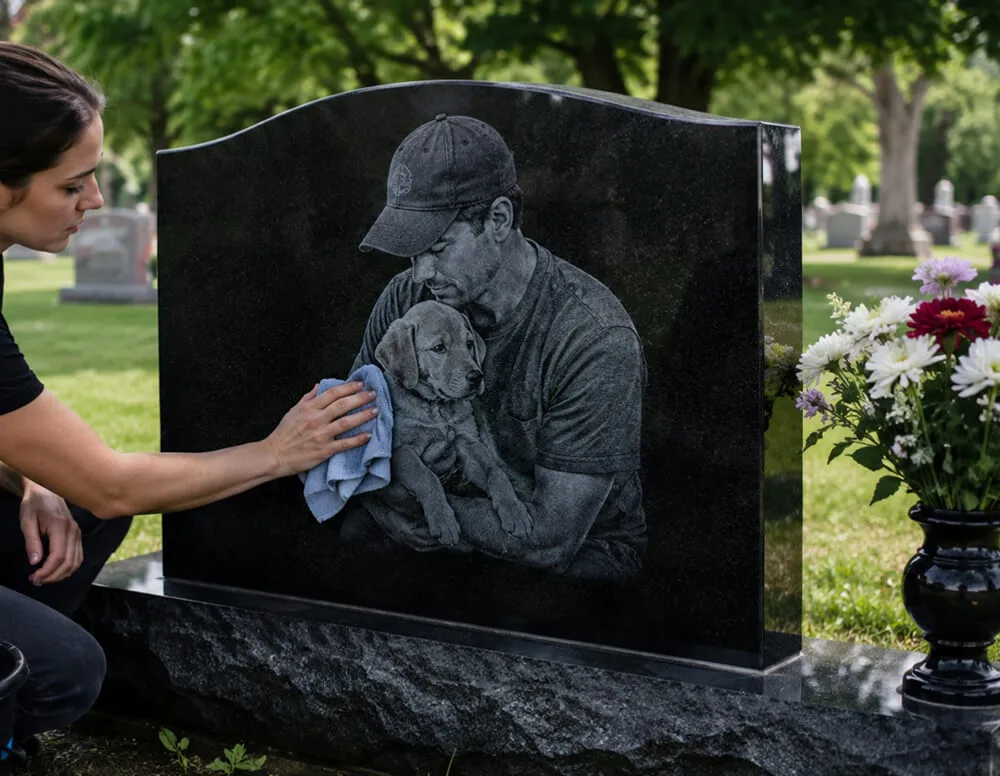
A family may choose a laser-etched headstone because a photo can say things that words can’t. A face, a flower, a farm, or a favorite place can become part of the stone.
This raises one important question: how long will the image last?
A good laser etching on quality black granite can stay clear for many decades. The stone may last much longer. The final life of the image depends on the granit, polish, depth of the engravng, climate, and care.
How Does Laser Etching Work?
Laser etching is different from paint or printing.
A laser beam strikes the polished stone surface. It removes tiny parts of the dark surface and exposes a light mark. Thousands of these marks form letters, portraits, and other images.
The picture isn’t a sticker. It doesn’t sit on top of the stone like a printed photo. This gives laser etching strong durabilty.
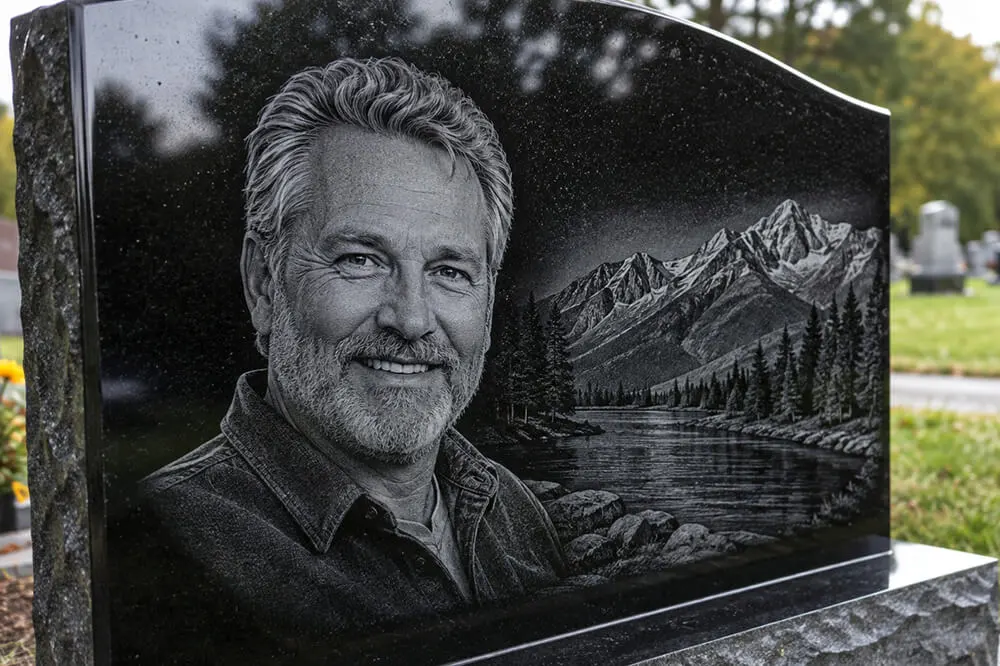
Black granite works well for this process. Its dark polished face creates strong contrast with the pale etched marks. Memorial companies use black granite for portraits, landscapes, animals, and fine artwork for this reason. Justhighstone.com states that black granite gives strong contrast for laser-etched images and that granite has high resistance to outdoor weather.
Can a Laser-Etched Image Last 50 Years?
Yes, it can.
There isn’t one fixed life for every laser-etched headstone. A high-quality stone may keep its image for several decades. Some designs may remain visable much longer.
The stone has a major role.
Granite contains minerals such as quartz and feldspar. The U.S. Geological Survey notes that these silicate minerals resist acid attack better than calcite-rich stones such as marble. This helps explain granite’s strong record as a monument material.
This doesn’t mean granite is permanant. Water, frost, heat, dirt, algae, and pollution can affect stone surfaces. Climate and stone quality matter.
A deep, clear laser design on dense black granite has a better chance of keeping its detial than a weak etching on poor stone.
A Canadian Example
Canada gives a useful example outside the U.S.
Nelson, a Canadian monument maker with more than 100 years of business history, uses granite for cemetery memorials. One monument in its Artisan Collection uses black granite with a laser-engraved forest scene. The light image stands against the dark polished stone.
This type of design shows why many familys choose laser work. A person may have loved forests, fishing, mountains, pets, or sports. Those memories can become part of the memorial.
You don’t have to limit a headstone to a name and two dates.
What Can Make the Etching Lose Clarity?
Several things can affect the image.
Low-grade stone can have mineral spots or cracks. A weak polish can reduce contrast. Poor laser settings can create shallow marks. Harsh wheather can place more stress on the exposed stone face.
Dirt can cause another problem. An image may look faded when the real cause is surface buildup.
Granite needs little maintenence, but gentle care helps. Water and a soft brush are safer choices than harsh household chemicals. Memorial care guidance also warns that biological growth and pollution can build up on outdoor stone.
You shouldn’t scrub an etched portrait with metal tools. They can damage the polished surface.
Is Laser Etching a Good Choice?
For portraits and detailed artwork, it’s a strong option.
Laser work can capture eyes, hair, clothes, flowers, buildings, and landscapes with more fine detail than many traditional cutting methods. It won’t replace deep-cut lettering for every design. The two methods can work on the same memorial.
If you’re buying a laser-etched headstone, ask about stone grade, polishing, image preparation, laser depth, and cleanning instructions.
We’ve seen memorial design move far beyond plain lettering. A headstone can tell part of a person’s story.
Good material and good workmanship matter most.
The laser creates the picture, but the stone carries the memory.