📜 Table of Contents
Faith · Law · Memory · Identity
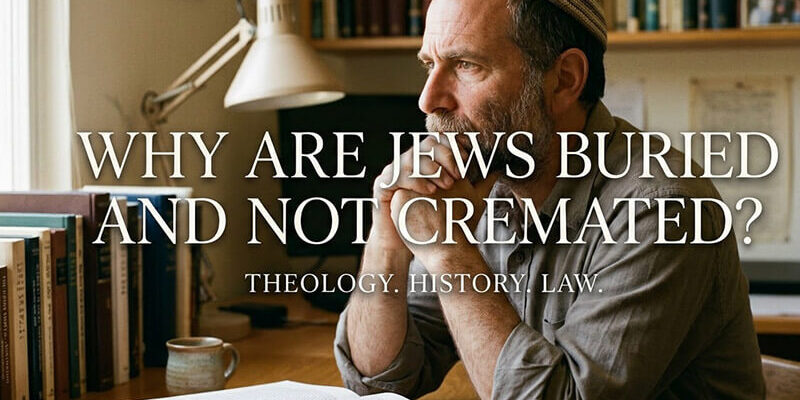
Why Are Jews Buried
and Not Cremated?
From ancient scripture to the shadow of the Holocaust —
the deeply human reasons behind a millennia-old tradition.
The Sacred Body: A Jewish Worldview
According to Judaism, the human body is not simply a container for the soul that the soul throws away when the person dies.
It is something much more significant — a creation of God, temporarily entrusted to each person, and worthy of reverence not only during life but also after death.
Indeed, these very words form part of the most persistent and easily identifiable gesture in the entire Jewish tradition: burial in the earth, no cremation.
The Hebrew idea of k’vod ha-met (Honor to the dead) means that the body should be afforded the same respect in death as it was in life.
Burning it is not liberation but defilement. This is not a mere superstition, rather it is a thoroughly contemplated theology that has been evolving for over three thousand years.
💬 “The body is God’s, we just take care of it for God while we live. After death, we give it back, in one piece.”
— Rabbi Joseph Telushkin, Jewish Literacy, 1991
What Scripture and Jewish Law Actually Say
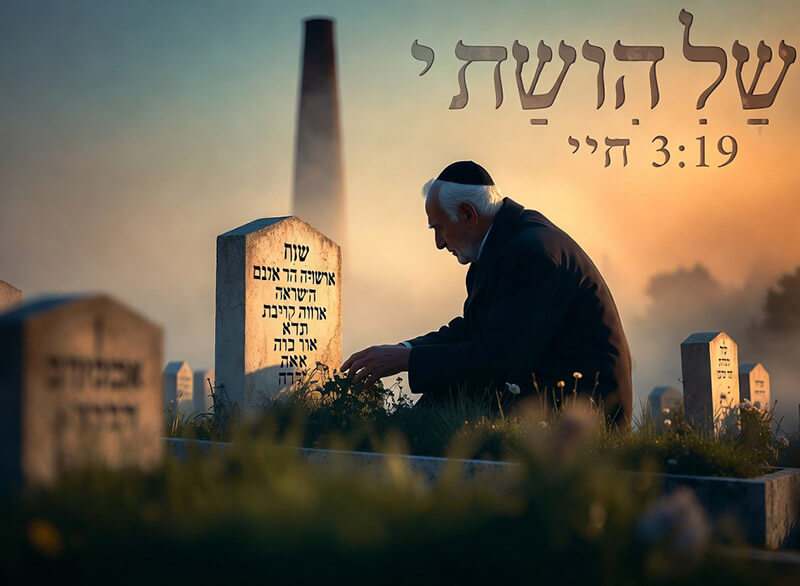
The main source for Jewish burial tradition is Genesis 3:19: “By the sweat of your face you shall eat bread, till you return to the ground, for out of it you were taken; for dust you are, and to dust you shall return.” This is not simply considered as poetry, it is interpreted as a theological directive rather than a literal command. Since the body was formed from the earth, returned to the earth intact.
The SA (Shulchan Aruch), the authoritative code of Jewish law that was put together in the 16th century, does not even mention cremation since it was a practice that was not practiced by Jews in the ancient world. Nevertheless, many rabbinic authorities have ruled that cremation is a breach of the burial commandment (kevurah) and a disgrace to the dead (nivul ha-met).
The Rituals of a Jewish Burial
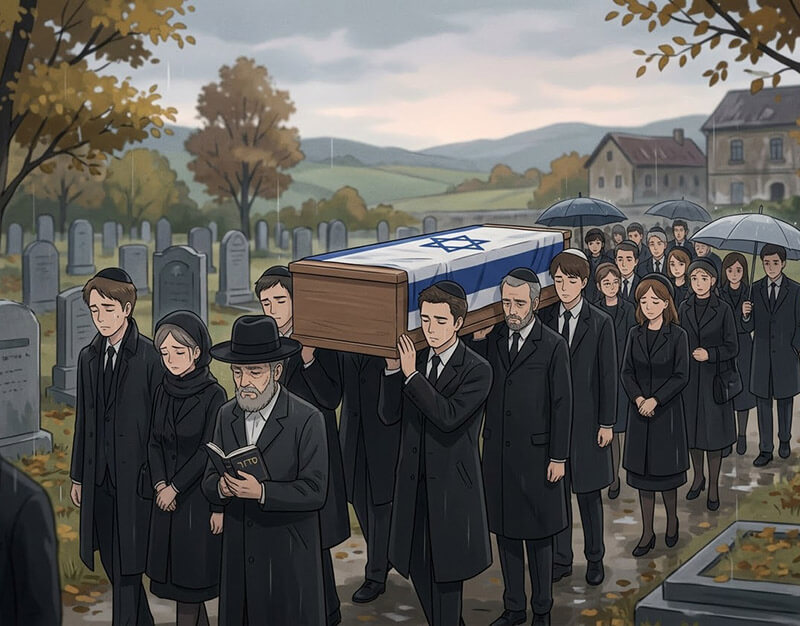
Jewish burial is not simply placing a body in the ground; rather it is carefully structured / carefully designed, that aim to honor the deceased and help the soul carry on its journey. The whole undertaking is entrusted to CK (Chevra Kadisha), the community of volunteers who consider this service as one of the holiest a Jew can perform.
- Shmirah (Watching): As soon as someone passes away, the body is guarded until it is laid to rest. The person who watches is called a shomer, and they usually read Psalms.
- Taharah (Purification): The CK ritually wash and purify the body. It is done with great solemnity and silence.
- Tachrichim (Shrouds): The corpse is wrapped in simple white fabric shrouds, the same for the rich and the poor. one of the principles of Jewish burial is that there should be no difference in wealth.
- Simple Coffin: In most cases, a plain wooden coffin is used (or no coffin at all in Israel), in order to make the decomposition of the body as rapid and natural as possible.
- Swift Burial: Ideally, burial should be done within 24 hours of one’s death, so as to express a feeling of importance and respect.
💬 “When I did taharah for the first time, I realized something about death that I had never thought about before. We were not treating a dead body; we were respecting a person.”
— Miriam Feldman, Chevra Kadisha volunteer, New York, interviewed by JTA, 2021
Real Stories: When Families Had to Choose
The conflict between sticking to one’s heritage and adapting to modernity is probably most obvious in how Jewish families deal with death. Many people who have stopped regularly practicing their religion still experience a strong attraction to burial, not out of legal obligation, but by a force that is difficult to explain.
“My mother was totally non-religious, she ate shellfish and worked on Saturdays. Yet at the moment of her death, she held my hand tightly and said, ‘Don’t turn me into ashes. Bury me.’ I didn’t ask what was the reason. I felt that it was about being Jewish. About belonging to something larger than herself.”
— David Horowitz, Los Angeles, as narrated to the Forward newspaper, 2022
Communities all over the world repeat this feeling. A 2022 research by JFNA shows that 64% of Jewish respondents, including those who said they were non-religious, favored burial as it gave them a feeling of connection to their ancestors and Jewish identity. From this point of view, the cemetery is not merely a place of rest but also a living record of the people.
The Long Shadow of the Holocaust
It is impossible to speak about Jewish views on cremation without mentioning the Holocaust. The Nazis killed about six million Jews from 1941 to 1945. To efficiently destroy the bodies of their victims, hide the evidence, and deny them any form of dignity or final resting place, the Nazis used large-scale crematoria at these death camps: Auschwitz-Birkenau, Treblinka, and Sobibor.
“Never shall I forget that night, the first night in camp, that turned my life into one long night seven times sealed… Never shall I forget those flames which consumed my faith forever… Never shall I forget those moments which murdered my God and my soul and turned my dreams to dust.”
— Elie Wiesel, Night (1960). Wiesel was a Shoah survivor, author, and Nobel Peace Prize laureate.
For survivors of the Holocaust and their children, the image of the crematorium will never be a neutral symbol. To them, it represents the killing of millions of people. Indeed, many victims at the camps even expressed burial as their last wish. Besides, there are still many Jewish families today, even those without a direct connection to the Holocaust, who reject cremation on the basis of the collective memory of the Holocaust which is deeply etched in their being. The body has to be given a grave. A grave symbolizes the presence of a person. A person who was present cannot be obliterated.
Do All Jewish Denominations Agree?
It is important to note that Jewish law is not standardized, and various denominations have come to different decisions regarding cremation, with all sharing the preference for burial as the primary option.
| Denomination | Position on Cremation |
|---|---|
| Orthodox (OU) | Forbids in very strong terms. Cremated remains are not allowed to be buried in a Jewish cemetery. |
| Conservative (USCJ) | Disapproves strongly. Some rabbis allow burying of ashes in a Jewish cemetery. |
| Reform (URJ) | Everyone’s choice. Burial is still considered the ideal but cremation is not forbidden. |
| Reconstructionist | Stresses individual autonomy. Both burial and cremation are seen as acceptable. |
In 2024, the CCAR reiterated that burial is the preferred Jewish tradition but ultimately, individuals and families make the decision. This is in line with the Reform movement’s general value of personal autonomy within a Jewish context.
Statistics: Burial Trends Today
📊 Main data points:
• The National Funeral Directors Association (NFDA) has revealed that the US cremation rate overall has reached 60.5% in 2023, which is a record high.
• The rate of Jewish cremation stays significantly low, estimated to be 25–30% for all denominations and even as low as 5% for the Orthodox Jews.
• A 2023 survey conducted by JFNA has revealed that 78% of Orthodox Jews, 61% of Conservative Jews, and 44% of Reform Jews still opt for traditional burial.
• It is no wonder that the practice of cremation is kept at bay in Israel — less than 1% of the Jewish population there choose it, and there are only a few crematoria countrywide.
Key Abbreviations
| Abbr. | Full Form |
|---|---|
| SA | Shulchan Aruch (Code of Jewish Law) |
| CK | Chevra Kadisha (Holy Society) |
| JFNA | Jewish Federations of North America |
| JTA | Jewish Telegraphic Agency |
| Shoah | Hebrew for Holocaust (“catastrophe”) |
| OU | Orthodox Union |
| USCJ | United Synagogue of Conservative Judaism |
| URJ | Union for Reform Judaism |
| CCAR | Central Conference of American Rabbis |
| NFDA | National Funeral Directors Association |